

OCM July Market Update
The physical gold market and precious metal equity sector have both endured a tumultuous first six months of 2026 as gains from 2025 are consolidated. We’ve seen Federal Reserve (The Fed) appointment pressure, Iranian War drama, and recently a short-term recoupling of gold and rates.
In this edition of ‘OCM Market Perspective’ we’ll touch on the M&A in gold equity space that has occurred over the past 6 months and the several short & long term themes impacting the gold price.
Gold Market M&A
Over the past month, the precious metal equity sector has witnessed four large deals that may set the table for the remainder of the year. Two acquisitions in G Mining (GMIN) acquiring G2 Goldfields (G2) and Agnico Eagle (AEM) consolidating Finland assets with its purchase of Rupert Resources, Aurion Resources, and buying out B2’s 70% JV stake. We also have two large mergers of producers with Equinox and Orla combining in North America along with a battle for Vault Resources in Australia between Regis Resources and Genesis Minerals.
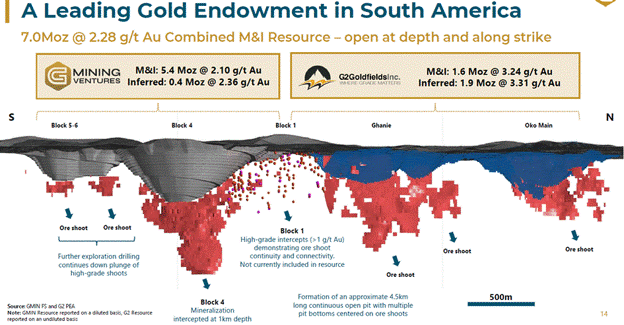
While the climate of the Finland and Guyana jurisdictions could not be more different, both projects demanded a similar premium. Agnico paid an approximate 67% premium for Rupert and GMIN paid an approximate 72% premium for G2, based on 30 day VWAPs. This is an increase from historical 30% premiums offered on most mining deals over the last ten years. The higher premiums are positive for the market as it communicates that high quality ounces won’t sit in the ground for decades, toiling away in the development process. Producing companies will pay well to mine them as resources at operating mines become depleted. They will also pay well for projects located in safe and mining friendly jurisdictions. Both Finland and Guyana have emerged as areas that provide clear pathways to extracting gold in a responsible but timely manner.
These premiums also display a growing theme that larger acquiring companies are willing to wait and pay for projects that have been de-risked compared to attempting to buy smaller and cheaper assets with less development. Not a strategy we totally agree with. The final positive of the two deals is that they’ll ideally free up money from both projects and be re-invested into new ideas in the exploration/development sector.
In a world of chasing flows, the North American and Australian mergers should provide more institutions the ability to get involved in the gold equity space. There are relatively few options for producers who will produce over 1,000,000 ounces annually and subsequently command a suitable market cap that will appease the appetite of larger institutions. For the newly formed Equinox, they will have minimal competition for investors who want to focus solely on North America until Barrick unleashes its “Barrick North America” company, potentially to IPO later this year.
In our opinion, there are no immediate synergies to be gleaned from these moves. However, after speaking to Regis management at the Canaccord conference in May in Henderson, Nevada, the company sees $500M-$750M AUD in tax savings due to the merger should it win the battle with Regis for Vault
Lastly, Allied Gold and Zijin Mining agreed to a deal for the Chinese major producer to acquire Allied in January 2026. The C$5.5 billion dollar deal has yet to close and the closing date has been pushed back over a month as it is rumored Chinese officials are conducting further due diligence due to Allied’s Sadiola mine in Mali. Historically, the Chinese have been the most aggressive with jurisdictional risk and thus the current deal delay is somewhat surprising. While the West Africa discount has been known for years, the lack of a swift deal with Zijin does add another perceived hurdle for investors to warm up to allocating to companies in the West African region.
Gold Market Commentary
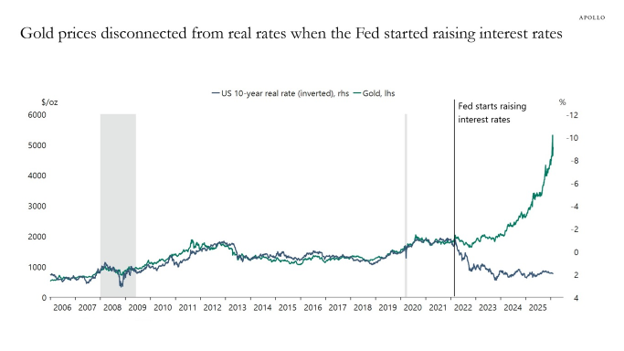
Source: Apollo, Torsten Slok (February 2026)
As discussed in our intro, the Iran War has continued to have an impact on both gold and gold equities. The relatively short-term rise in the oil price led to Fed (The Federal Reserve) watchers predicting that rates will hold steady, if not be raised, under new Fed Chair, Kevin Warsh. The war has reignited gold’s recoupling of its negative correlation with interest rates. Since the start of the Ukraine War in 2022 until the start of the Iran War in February 2026, gold had decoupled from real rates, seen in the chart immediately above.
The gold price now continues to see pressure due to inflationary expectations forcing the Fed to raise rates. In our opinion, the market’s inflationary expectations are an overall positive for gold in the long run with the Fed’s ability to raise rates, in our opinion, being limited due to the enormity of U.S. total debt. As we’ve mentioned in the past, gold has over a 90% correlation to total federal debt outstanding.
Via Reuters, the Pentagon estimated the War had a price tag of $1 billion per day after an initial cost of over $11 billion over the first six days of the conflict. Thus, the U.S. is currently facing nearly $100 billion in costs, purely based on Pentagon figures, which could be understated, in our opinion. However, the cost of the war pales in comparison as the United States has been on pace to add $5 billion of debt every day as we inch closer to a total of $40 trillion in total debt outstanding. Put another way, U.S. debt is over 120% of GDP, historically a level that has created monetary disorder for countries.
The continued piling on of federal debt coincides with a Washington Post report that “Trump administration officials have pressed the office responsible for the nation’s money to design a $250 bill featuring the president’s portrait.” As a reader and/or investor, we are confident that many know the history of the Weimar Republic’s inflationary history but the Washington Post report prompts the following two charts:
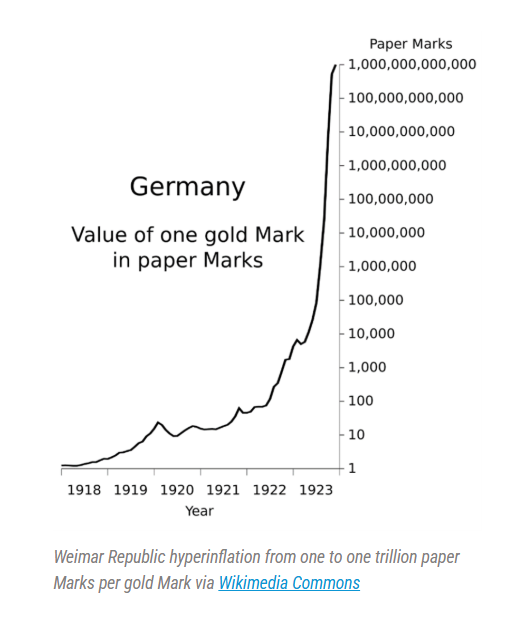
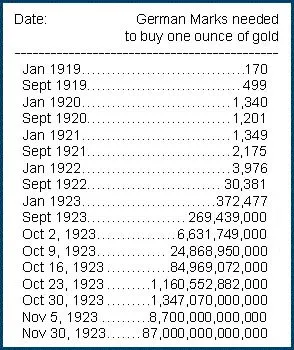
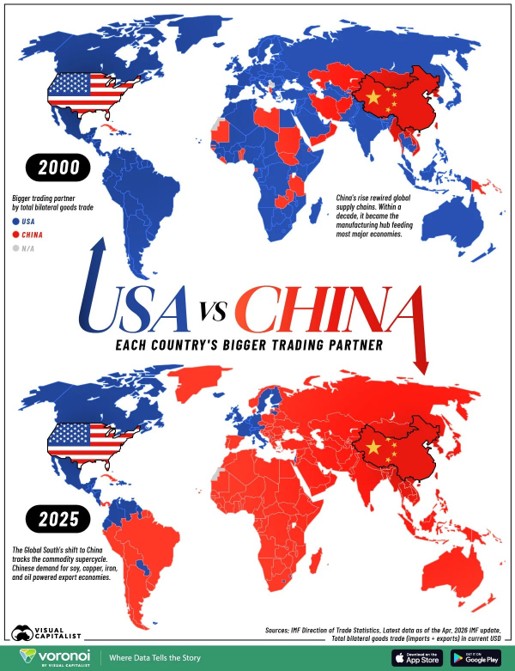
While China’s economy slowed this past month, the chart below shows that China has grown to become a formidable foe to the U.S. in terms of global trade and U.S. dollar hegemony. In our opinion, the Iran War is another example of how the U.S. is trying to hold onto reserve currency status and fend off Chinese competition. The overthrow of Venezuelan president Nicolas Maduro in January was partially due to Chinese involvement and extending its influence in South America, in our opinion. The Chinese have continued to put efforts into dominating global trade such as China’s funding the $1.3 billion deep-water megaport in the Port of Chancay in Peru.
When one combines further devaluation of the U.S. Dollar, lack of U.S. trade on the margins, and the Peoples Bank of China (PBOC) having to further manage the Yuan, gold comes out as the winning currency of choice, in our opinion. The PBOC appears to agree, per the World Gold Council: “PBOC announced its 19th consecutive monthly gold reserve increase in May, pushing official holdings 10t higher to 2,332t. This marks the strongest month of official sector gold purchases since December 2024. China’s official gold holdings have risen by 25t y-t-d and now account for 8.9% of China’s foreign exchange reserves. The country’s official sector has accumulated 67t of gold during the past 19 months.”
20260702-5711476
Important Disclosures
Important Disclosures
Investors should carefully consider the investment objectives, risks, charges, and expenses of the OCM Gold Fund. This and other important information about a Fund are contained in a Fund’s Prospectus, which can be obtained by calling 1-800-779-4681. The Prospectus should be read carefully before investing.
The Fund invests in gold and other precious metals, which involves additional risks, such as the possibility for substantial price fluctuations over a short period of time and may be affected by unpredictable international monetary and political developments such as currency devaluations or revaluations, economic and social conditions within a country, trade imbalances, or trade or currency restrictions between countries. The prices of gold and other precious metals may decline versus the dollar, which would adversely affect the market prices of the securities of gold and precious metals producers. The Fund may also invest in foreign securities which involve greater volatility and political, economic, and currency risks and differences in accounting methods. The Fund is non-diversified, meaning it may concentrate its assets in fewer individual holdings than a diversified fund. Therefore, the Fund is more exposed to individual stock volatility than a diversified fund. Prospective investors who are uncomfortable with an investment that will fluctuate in value should not invest in the Fund.
Past performance is no guarantee of future results
There is no guarantee that the Fund will achieve its objective. Diversification does not ensure a profit or guarantee against loss. The prices of securities of gold and precious metals producers have been subject to substantial price fluctuations over short periods of time and may be affected by unpredictable international monetary and political developments, such as currency devaluations or revaluations, economic and social conditions within a country, trade imbalances, or trade or currency restrictions between countries. The prices of gold and other precious metals may decline versus the dollar, which would adversely affect the market prices of the securities of gold and precious metals producers. Because the Fund concentrates its investments in the gold mining industry, a development adversely affecting that industry (for example, changes in the mining laws which increase production costs) would have a greater adverse effect on the Fund than it would if the Fund invested in a number of different industries.
Funds are distributed by Northern Lights, LLC, FINRA/SIPC. Orrell Capital Management, Inc. and Northern Lights Distributors, LLC are not affiliated.