

OCM August Market Update
Last week, gold and gold equities enjoyed a rally after suffering from summer doldrums and continued Iran War pressure. Below are four fundamental features we believe help explain why the rally is a positive step in the ever-evolving landscape of the gold equity sector.
Yen Intervention – Gold’s Gain

Source: Financial Times/ Kiyoshi Ota/ Bloomberg
From Barry Eichengreen of the Financial Times:
“Both moves (Foreign and International Monetary Authorities Repo Facility and Selling Euros) are an indication that the dollar’s status as a reserve currency is not what it used to be. Central banks are accustomed to holding foreign reserves in dollars because markets in US Treasury securities are liquid. Central banks hold US Treasuries because they can be freely bought and sold and used in interventions. But not now, at least not in unlimited quantities. Instead, we see the US Treasury stepping in with euro sales as part of its contribution to the intervention, thus limiting the volume of dollar sales needed by the Japanese authorities.”
As we mentioned in our July Market Update, the benefactor of more countries trading with China or central banks potentially decreasing USD reserves, is gold. While the US Dollar may not lose its reserve status tomorrow, any loss on the margins may find its way to gold. Gold’s lack of a counterparty is an enticing feature, as the author indicates with his closing paragraph:
“The bottom line is that Washington, fearing the consequences for US financial markets, is reluctant to see foreign central banks use their dollar reserves. This is telling us that the dollar is not the attractive reserve currency it once was. When this message sinks in, other countries will redouble their search for more attractive, readily usable alternatives. Reserve diversification is apt to gather steam.” On a related note, we found Sean Darby’s (Equity Analyst for Mizuho Securities Asia Limited) view of the Asian impact on the USD to be consistent with the trending change in reserve asset status”:
“In Mizuho’s view, the inflation temperature in South Korea and Taiwan is set to rise too at a time when their exchange rates appear very undervalued to the dollar. Meanwhile, China has begun a policy to liberalize the trading of the yuan offshore which should speed up the internationalization of the CNY reducing the need for the central bank to hold US treasuries. There is growing pressure on the North Asian net creditor nations to change their reserve assets.”
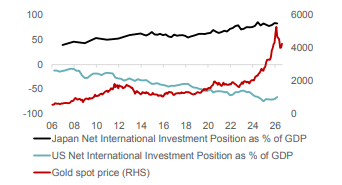
Source: Bloomberg, Mizuho Securities Equity Research
Gold Producers Rewarding Shareholders
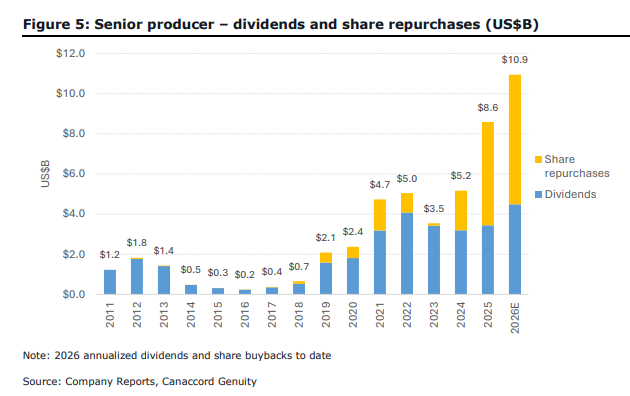
As we have written several times, it has been our belief that management teams in the precious metals sector learned from the mistakes made in the previous bull market (Roughly 2001-2011). The chart above from Canaccord Genuity helps illustrate our point. Gold producers have used record gold prices to help shareholders through unseen levels buybacks and dividends. The producers have been able to conduct this level of redistribution while maintaining balance sheet strength and thus optionality. If gold continues to maintain a $4,000 level floor (see our Central Bank Update below for more), the aforementioned balance sheet strength could lead to high quality M&A in the explorer and developer space of the sector.
A Shifting Currency Landscape – Gavekal
I implore you to read Gavekal’s article, authored by Louis-Vincent Gave and Romain Metivet’s, “A Shifting Global Currency Landscape.” Gavekal articulates that “a reserve currency has three attributes; it is (i) a medium of exchange, (ii) a reserve of value and (iii) a unit of account.” The authors explain, in detail that globally we no longer have a currency that fits the tri-leveled criteria. They argue gold and Honk Kong assets could be the benefactors of the new “landscape.”
Central Bank Gold Update
Central banks around the globe continue to add gold to their reserves and it appears that trend will not be stopping anytime soon.
China, who has been the most consistent buyer of gold of significant size, bought gold for the 21st consecutive month in July. Reuters reported that it was “the biggest monthly addition since October 2023.” Elsewhere in Asia, it has been reported earlier this month that the central bank of Korea is preparing for their first physical gold purchase in over 13 years. South Korea will be purchasing gold from in-country producers, which were previously exporting their production.
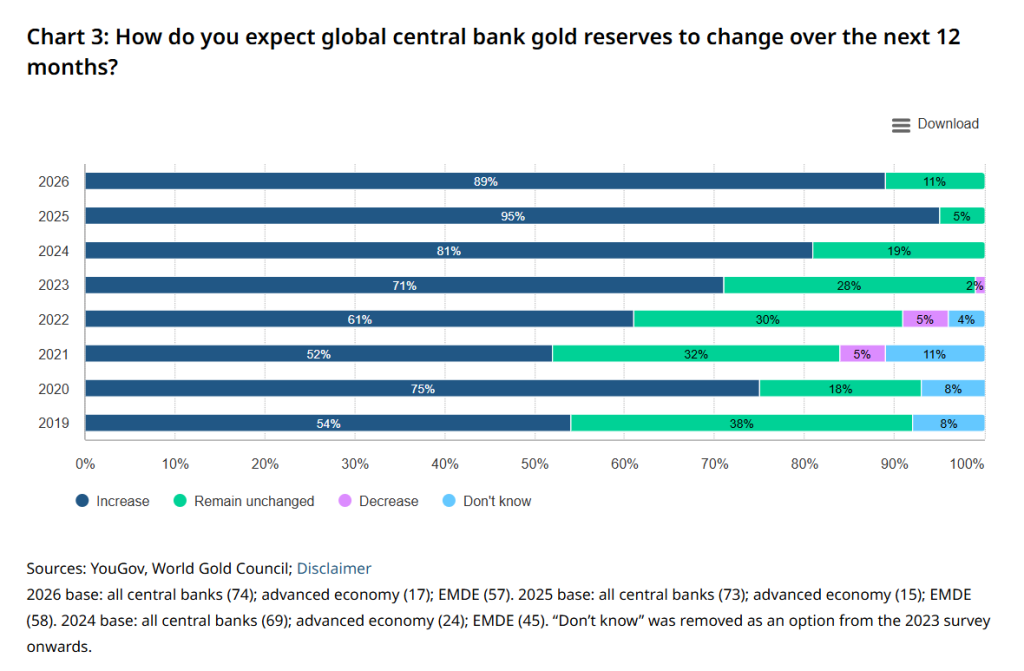
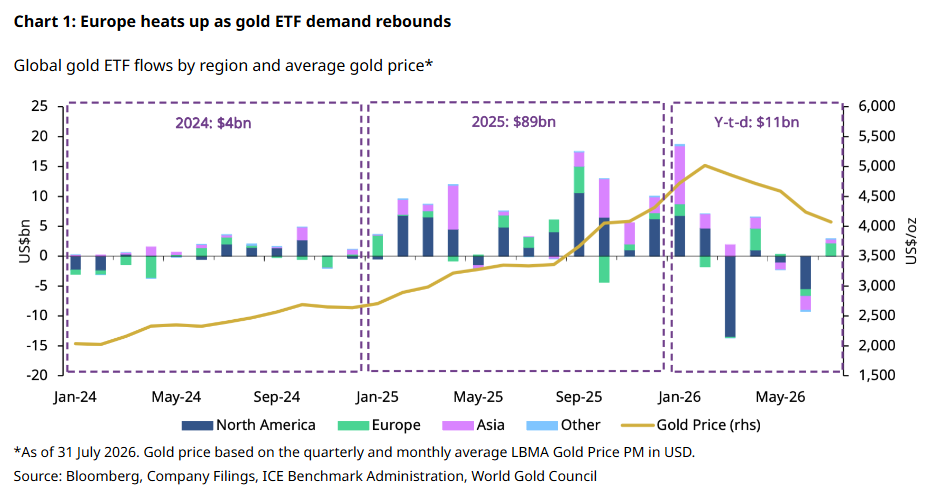
Per Bloomberg, Poland’s central bank has continued their gold buying spree this year, totaling 82 tons in 2026 through early July. “We’ve been consistently buying gold, taking advantage of the recent price drops,” said Adam Glapinski, Poland’s central bank governor. Lastly, in a World Gold Council central bank survey, 89% of central banks plan to increase gold reserves over the next 12 months, a 35% increase from just 5 years ago, as seen below. It appears, in our opinion, that central banks may be the buyers who have supported gold at the $3,900-$4,000 per ounce level throughout this summer. As shown in the 2nd chart below, North Americans were net sellers of gold via ETFs and providing the window for the CBs to be opportunistic buyers. If $4,000 becomes the floor for gold producers, the margins they will be able to enjoy for a considerable amount of time while sustaining re-distribution for shareholders should be enticing for investors not currently involved in the sector.
20260812-5831700
Contact Us
Phone: 1-800-779-4681
Email: info@ocmgoldfund.com
Website: 1-800-779-4681
Address: 2600 Kitty Hawk Road, Suite 119, Livermore, CA 94551
Important Disclosures
Investors should carefully consider the investment objectives, risks, charges, and expenses of the OCM Gold Fund. This and other important information about a Fund are contained in a Fund’s Prospectus, which can be obtained by calling 1-800-779-4681. The Prospectus should be read carefully before investing.
The Fund invests in gold and other precious metals, which involves additional risks, such as the possibility for substantial price fluctuations over a short period of time and may be affected by unpredictable international monetary and political developments such as currency devaluations or revaluations, economic and social conditions within a country, trade imbalances, or trade or currency restrictions between countries. The prices of gold and other precious metals may decline versus the dollar, which would adversely affect the market prices of the securities of gold and precious metals producers. The Fund may also invest in foreign securities which involve greater volatility and political, economic, and currency risks and differences in accounting methods. The Fund is non-diversified, meaning it may concentrate its assets in fewer individual holdings than a diversified fund. Therefore, the Fund is more exposed to individual stock volatility than a diversified fund. Prospective investors who are uncomfortable with an investment that will fluctuate in value should not invest in the Fund.
Past performance is no guarantee of future results
There is no guarantee that the Fund will achieve its objective. Diversification does not ensure a profit or guarantee against loss. The prices of securities of gold and precious metals producers have been subject to substantial price fluctuations over short periods of time and may be affected by unpredictable international monetary and political developments, such as currency devaluations or revaluations, economic and social conditions within a country, trade imbalances, or trade or currency restrictions between countries. The prices of gold and other precious metals may decline versus the dollar, which would adversely affect the market prices of the securities of gold and precious metals producers. Because the Fund concentrates its investments in the gold mining industry, a development adversely affecting that industry (for example, changes in the mining laws which increase production costs) would have a greater adverse effect on the Fund than it would if the Fund invested in a number of different industries.
Funds are distributed by Northern Lights, LLC, FINRA/SIPC. Orrell Capital Management, Inc. and Northern Lights Distributors, LLC are not affiliated.